

When I first started working in veterinary clinics here in Australia, I never thought much about who actually owned a pet’s medical records. As a veterinary nurse, I was focused on what was with the pets and their owners: the diagnosis, medications, blood results, imaging, treatment history and everything else a veterinary team needed to care for an animal properly.
Years later, when I became a pet owner myself, I started looking at veterinary records from a completely different perspective.
I wanted to know my pet’s history. I wanted to keep it somewhere safe, refer back to it and have it available if I changed veterinarians, moved house or needed emergency care. What surprised me was how complicated it could be for a pet owner to obtain and keep a complete copy of their animal’s veterinary records.
That experience eventually became one of the reasons I started thinking about Altruiss.
The more I looked into the issue, the more I realised that the question “Can I get my pet’s veterinary records?” does not have a simple yes-or-no answer in Australia. Veterinary medical records are generally considered the property of the veterinarian or veterinary practice that created them, but the rules and professional expectations around providing copies vary between Australian states and territories.
And that distinction matters.
Key takeaways:
- The original veterinary record and access to its information are not necessarily the same thing. A practice may retain ownership of the original clinical record while an owner receives a copy or summary.
- Australia does not have one uniform nationwide rule governing every request for a pet’s veterinary records. Requirements and professional expectations depend on the jurisdiction and circumstances.
- Veterinary records support continuity of care by helping another veterinarian understand previous diagnoses, treatments, medications, test results and clinical history.
- Veterinary practices have important responsibilities: records must remain accurate, complete, confidential and professionally managed.
- Pet owners also need practical access to their pet’s history, especially when changing clinics, travelling or seeking emergency or specialist care.
- A portable pet health history does not need to replace the official veterinary record. It can provide a secure place for owners to organise and retain the information they have received.
“The key question is not simply who owns the original record. It is how the information can remain available to support the animal’s care.”
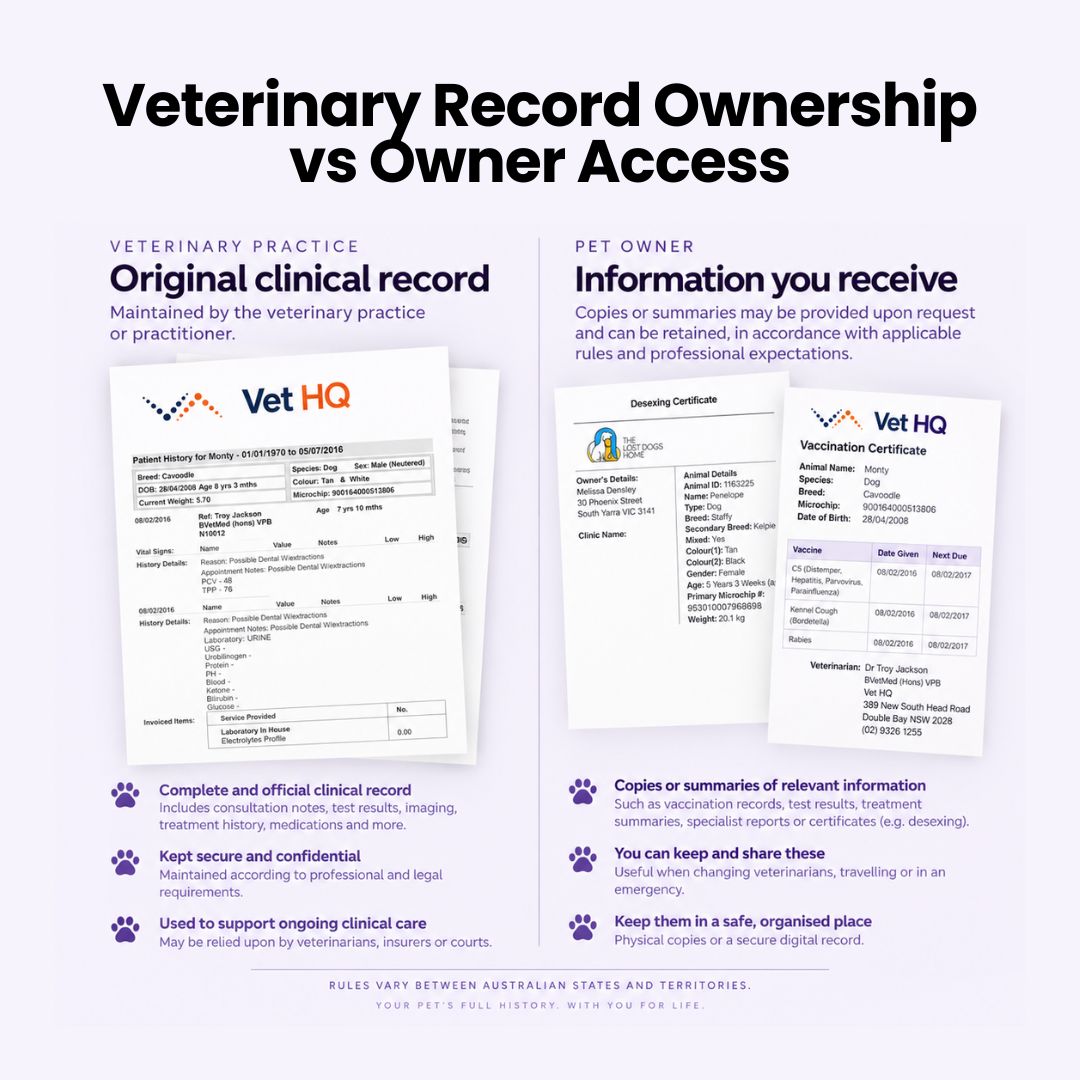
Who owns a pet’s veterinary records in Australia?
In Australia, veterinary medical records are generally considered the property of the veterinarian or veterinary practice that created or contributed to them. The Australian Veterinary Association has also recognised that veterinary medical records and diagnostic images remain the property of the veterinarian or veterinary practice.
That does not necessarily mean a pet owner can never receive a copy.
It means that ownership of the original clinical record and a pet owner’s ability to access the information within that record are two separate questions.
This distinction is important because veterinary records are not just administrative paperwork. They can contain an animal’s medical history, diagnoses, laboratory results, imaging, surgical records, anaesthetic records, medications, specialist reports and treatment plans.
In Victoria, the Veterinary Practitioners Registration Board explains that veterinary medical records are the property of the veterinary practice or practitioner who created or contributed to them. The Board also explains that records are created and maintained to support the ongoing care of an animal.
“A veterinary medical record is the property of a veterinary practice or veterinary practitioner who has created or contributed to it.”
— Veterinary Practitioners Registration Board of Victoria, Guideline 07: Veterinary medical records
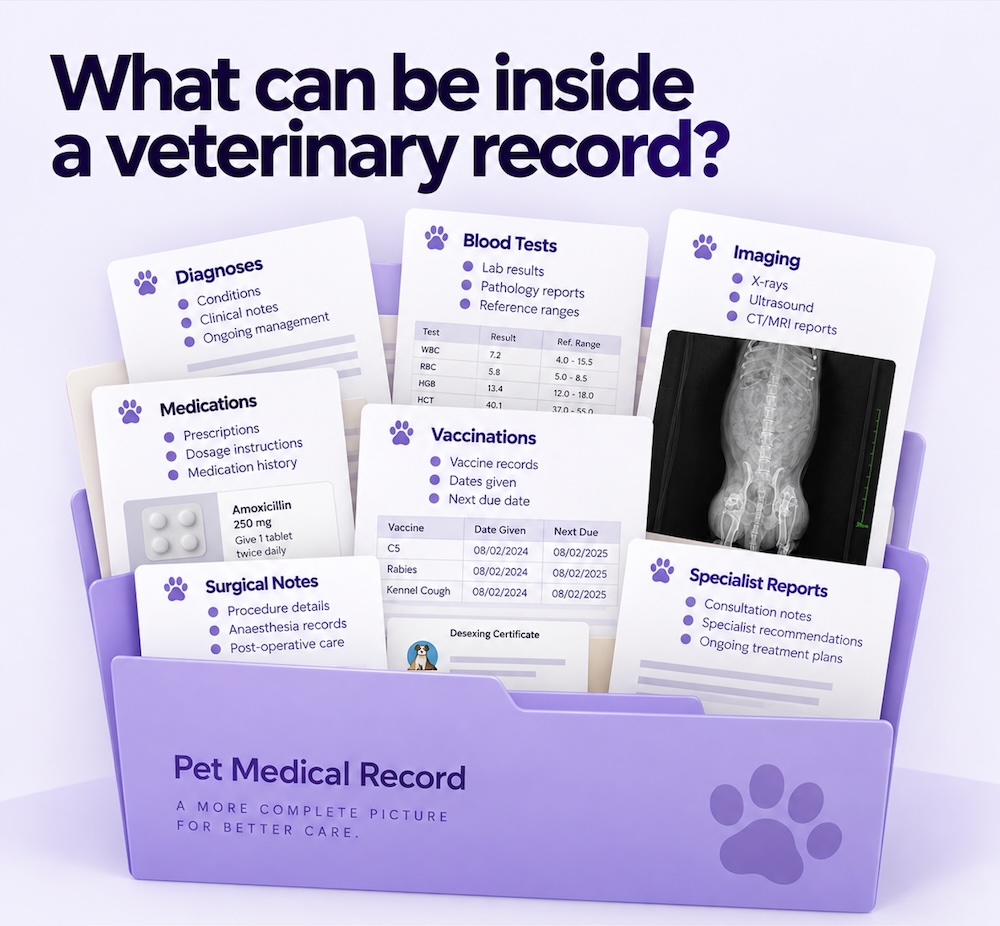
Can Australian pet owners request a copy of their pet’s vet records?
The practical answer is: often yes, but the legal position is not identical across Australia.
Victoria provides a useful example of why the issue is more nuanced than the statement that “pet owners cannot get their vet records.” The Victorian Board states that a veterinary practitioner is not legally required to provide copies if there is a reasonable justification not to do so. However, its general expectation is that a veterinary practitioner should provide a copy of the animal’s veterinary medical records or a summarised clinical history to the owner or their representative when requested.
If the practitioner decides not to provide the records, the Board says the owner should be given an effective explanation for that decision.
The exact requirements should always be checked with the relevant state or territory regulator.
Why can getting your pet’s veterinary records be difficult?
I understand why veterinary practices have rules around medical records. I worked inside that system for years.
A veterinary medical record is a professional document. It needs to remain accurate and complete. It may be relied upon by other veterinarians, regulators, insurers or courts. Veterinary practices also have obligations around confidentiality, retention and record keeping.
That means the original clinical record should not simply become an editable document that anyone can change.
“Protecting the integrity of the original record and helping pet owners access their pet’s history can exist at the same time.”
A veterinary practice can retain the original clinical record while a pet owner maintains a secure, read-only copy of the documents they have received. The owner can then keep that history available when they need it without changing the original clinical documentation.
Pets do not stay in one veterinary clinic for their entire lives. They move, their families relocate, they see emergency hospitals, they get referred to specialists and they may need care while travelling.
“How does the pet’s medical history move with them?”
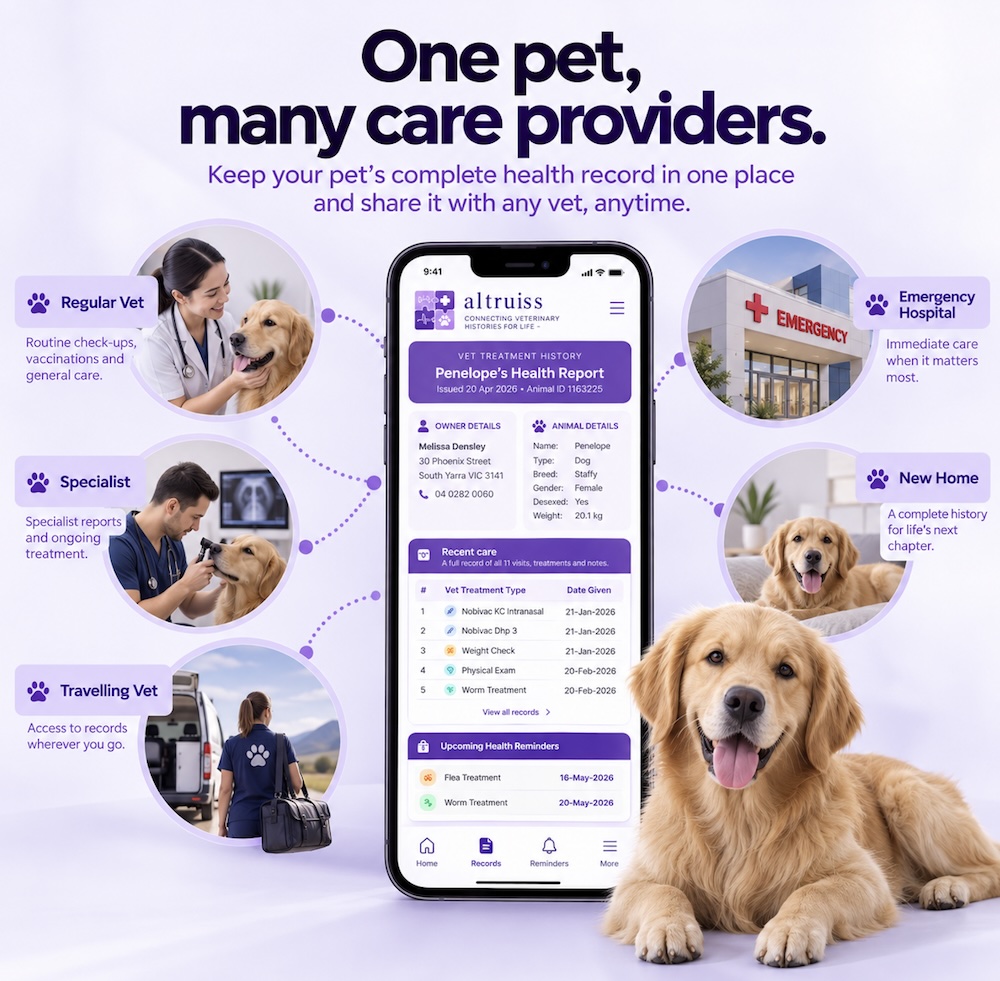
What happens when you change veterinarians?
Changing veterinarians is one of the clearest examples of why access to veterinary records matters.
A new veterinarian may need to know about previous diagnoses, medications, allergies or adverse reactions, vaccination history, laboratory results, previous surgeries, imaging, specialist consultations and previous responses to treatment.
Without that information, the new veterinarian may need to rely on whatever the owner remembers and whatever information can be transferred from the previous practice.
Australian veterinary regulators recognise the importance of continuity of care. Victoria’s guidance says records should contain sufficient information for a professional peer to continue the care and treatment of an animal if necessary. It also explains that, when an owner requests a transfer to another veterinarian for a second opinion or ongoing care, the practitioner should provide the records to the other veterinary practitioner.
As someone who has worked in veterinary practice, I know how much easier it is for a veterinarian to make an informed decision when they can see the relevant history. As a pet owner, I also know how difficult it can be to remember every appointment, every medication and every test result your pet has ever had.
The responsibility for remembering a pet’s entire medical history should not sit entirely on the owner.
“A complete history helps the next veterinary team understand what has already happened, what has been tried and what information may be important for the animal’s ongoing care.”
Your pet’s medical history is more than a stack of PDFs
Even when an owner successfully obtains their veterinary records, the information may not be particularly easy to understand.
A veterinary record is written for veterinary professionals. It may contain abbreviations, clinical terminology, laboratory values, imaging reports and treatment notes that can be overwhelming for a pet owner.
That is one of the reasons I believe pet health technology needs to do more than simply store documents.
Pet owners need access to the original information, but they also need a way to organise it and understand the bigger picture.
What happens to your pet’s records when a veterinary clinic closes?
Veterinary practices can change ownership, merge with other practices or close. When that happens, the practice still has obligations around retaining veterinary medical records.
In Victoria, for example, the regulator explains that when a veterinary practice closes, records may be transferred to another veterinary practitioner or, in some circumstances, given to the animal’s owner, while retention obligations still apply.
Keeping copies of important documents can therefore be a practical step for pet owners. It does not change who is responsible for the official clinical record; it simply gives the owner another place to retain the information they have received.
Australia is not the only country dealing with veterinary record ownership
Australia is not the only country where veterinary practices own the original medical record.
In Ontario, Canada, the College of Veterinarians of Ontario explains that the physical medical record belongs to the veterinary clinic, but the information contained in the record belongs to the client. The College states that veterinarians are required to provide a copy of the requested components of the medical record upon request, including a request for the complete medical record.
This is a useful international comparison because it shows that maintaining professional ownership of the original record and providing clients with access to the information are not mutually exclusive.
Ontario’s rules are not Australian law. They are included to illustrate a different regulatory approach.
“The physical copy of the medical record is the property of the veterinary clinic, but the information contained in the record belongs to the client and the client has the right to access the content of the record.”
— College of Veterinarians of Ontario, Practice Advisory Service
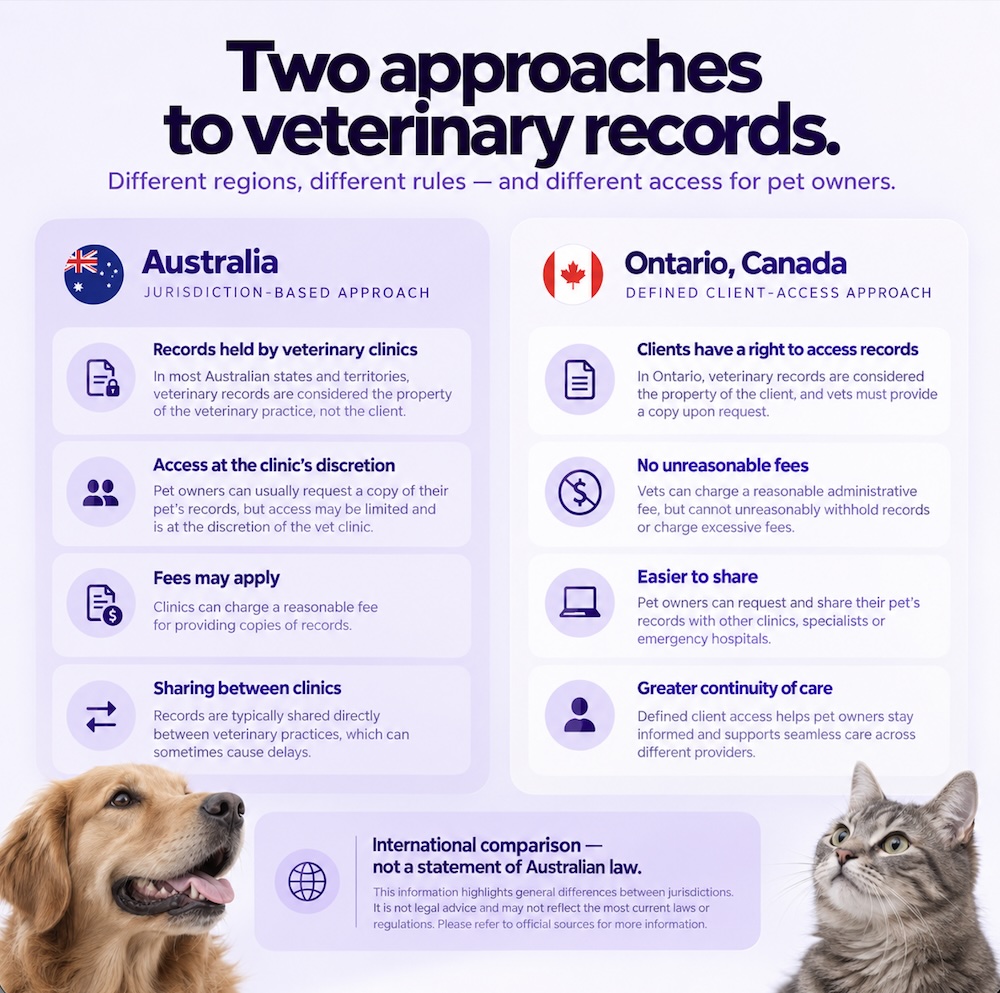
Does Australia need a more portable approach to pet medical records?
I don’t think this is a question of choosing between veterinarians and pet owners.
Veterinary practices need accurate clinical records. They need to protect confidential information. They need to comply with legislation and professional standards. They need to be able to demonstrate what treatment was provided and why.
Pet owners need something different: continuity.
They need to know what happened to their pet yesterday, last year and five years ago. They need to be able to give a new veterinarian the information they need. They need to find a blood test when an emergency veterinarian asks for it among other records. They need to know which medication their pet previously received.
These needs are not in conflict. In fact, they support each other.
That is the idea behind Altruiss. I did not want to create another veterinary practice management system or replace the systems veterinarians already use. I wanted to solve the problem I had experienced from the other side: how can a pet have a health history that stays with them?
With Altruiss, pet owners can keep their veterinary documents together, organise their pet’s health information and make it available when they need it. The goal is not to replace the original veterinary record. It is to give owners a secure, portable place to keep the information they have received about their pet.
“How can a pet have a health history that stays with them?”
So, can you get your pet’s veterinary records in Australia?
The safest answer is: it depends on where you live and the circumstances of your request.
Australian pet owners do not have one uniform nationwide legal right to their pets’ veterinary records. Veterinary medical records are generally considered the property of the veterinarian or veterinary practice, and the rules around providing copies vary between jurisdictions.
However, it would also be misleading to say that Australian pet owners simply cannot get their pet’s records.
In Victoria, the regulator’s general expectation is that veterinarians provide a copy or summary to an owner on request, while recognising limited circumstances where access can be refused. Across these guidelines, there is also a strong emphasis on transferring information when another veterinarian needs it to provide ongoing care.
The real challenge is making pet health information simple to access, organise and keep available over time, while respecting the professional responsibilities attached to the original record.
As someone who has spent years working in veterinary medicine and has experienced this issue as a pet owner, I keep coming back to the same thought:
“A pet may have many veterinarians throughout its lifetime, but it only has one medical history.”
That history should be able to follow the pet. Not just the clinic. Not just the software. Not just the email inbox where someone happened to send a PDF five years ago.
Because ultimately, this is not really about who owns a file. It is about making sure that when a pet needs care, the right information is there.