As a veterinary nurse with more than 10 years of experience, I created this puppy care guide to help first-time puppy owners understand what their new puppy needs to get the healthiest possible start in life.
Bringing home a puppy is one of the most exciting experiences you can have. It is also one of the biggest responsibilities.
Over the years, I have worked with countless puppies and their families in veterinary practice. One thing I have learned is that new puppy owners rarely struggle because they do not care enough. Quite the opposite. They usually have too many questions.
What should my puppy eat? When should they be vaccinated? How often do puppies need worming? When can they go outside? Is this behaviour normal? What if they are sleeping too much? Should I give them vitamins? When should I be worried?
I have heard these questions time and time again.
The good news is that you do not need to know everything on day one. You simply need to understand the foundations of good puppy care and, importantly, know when to ask for help.
Whether you are caring for a puppy as a first time owner or simply want to make sure you are giving your new companion the best possible start, these are the areas I recommend focusing on.

Your First Veterinary Visit Should Happen Early
One of my biggest recommendations when caring for a puppy as a first time owner is not to wait until something goes wrong before establishing a relationship with your veterinarian.
Ideally, your puppy should have a veterinary examination soon after coming home. Bring any paperwork supplied by the breeder, rescue organisation or previous veterinarian, including vaccination records, microchip information, worming history and details about what your puppy has been eating.
Your veterinarian can assess your puppy's overall health, listen to their heart and lungs, check their eyes, ears, mouth and body condition, and discuss their individual healthcare needs.
This first appointment is also where you can start building your puppy's parasite preventative care plan.
Rather than thinking of veterinary care as something you only need when your puppy is sick, I encourage owners to think of it as an ongoing partnership. Your veterinarian can help you make decisions about vaccinations, parasite prevention, nutrition, dental care, behaviour, socialisation, desexing and breed-specific health risks.
Understanding Your Puppy Vaccination Schedule
Vaccination is one of the most important parts of early puppy healthcare because young puppies are particularly vulnerable to serious infectious diseases.
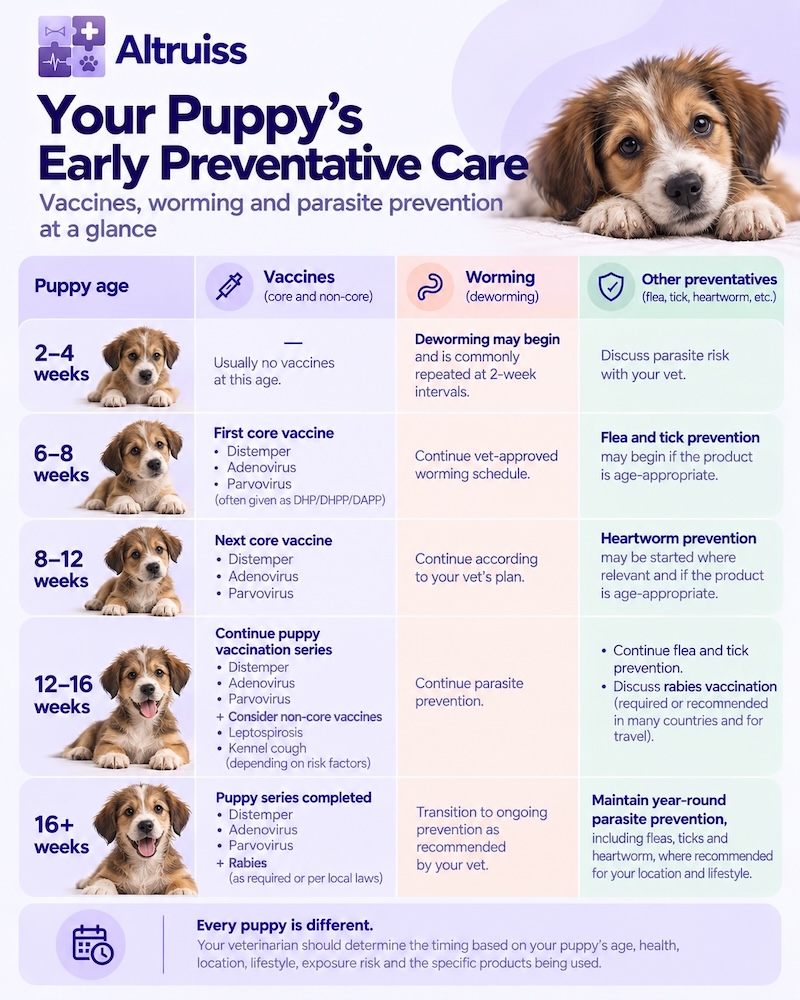
There is no single puppy vaccination schedule that is appropriate for every puppy. Your veterinarian will consider factors such as your puppy's age, health, vaccination history, location and disease risk.
In Australia, core puppy vaccinations generally begin from around 6–8 weeks of age and are repeated at intervals of 2–4 weeks, with the final puppy dose given no earlier than 16 weeks of age. Your veterinarian can advise you on the appropriate schedule for your individual puppy.
Depending on where you live and your puppy's lifestyle, your veterinarian may also discuss additional vaccines. For example, a puppy who will regularly attend boarding facilities, daycare or social environments may have different risks from a puppy who lives mostly at home.
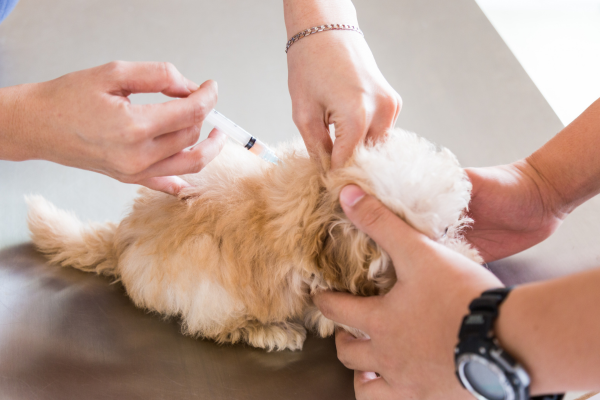
I always recommend keeping every vaccination record. Record the date, vaccine given and any relevant details so your veterinarian has an accurate history throughout your dog's life.
Being partially vaccinated does not necessarily mean your puppy needs to be completely isolated from the world. Appropriate, controlled socialisation is important during early development. Your veterinarian can help you find the right balance between infection risk and positive experiences.
What about rabies vaccination?
Rabies is an important vaccine to know about, although the recommendation depends heavily on where you and your puppy live.
Australia is currently free from classical rabies, so rabies vaccination is not generally part of the routine vaccination program for dogs living in Australia. However, rabies vaccination may be required when travelling internationally, particularly when entering or returning to countries with specific rabies-control requirements. If you are planning to travel overseas with your puppy, speak with your veterinarian well in advance.
Rabies vaccination, antibody testing and waiting periods can form part of the import or export requirements, and these requirements vary depending on the destination country.
Why Parasite Prevention Matters in Puppies
Worms in puppies are extremely common, which is why parasite prevention needs to be part of your puppy's healthcare plan from the beginning.
Roundworms, hookworms and other intestinal parasites can cause problems ranging from poor growth and gastrointestinal upset to much more serious disease. Some parasites can also have implications for human health.
A puppy deworming schedule is therefore not something I recommend guessing at.
Young puppies commonly require more frequent deworming than adult dogs. Parasite-control recommendations vary depending on the parasite, product, age, location and individual risk.
Your veterinarian may also recommend faecal testing. This can be particularly useful because seeing no worms in your puppy's stool does not necessarily mean they have no parasites.
The key lesson from my years in practice is simple: do not wait until you see worms to start thinking about parasite prevention.
Your puppy's preventative plan should eventually cover the parasites that pose a meaningful risk based on where you live and your puppy's lifestyle.
Build a Preventative Schedule
When I talk to new puppy owners, I often encourage them to think in terms of a preventative schedule, rather than individual appointments.
Your puppy's healthcare calendar may eventually include:
- Vaccinations and health examinations
- Intestinal parasite control
- Flea and tick prevention
- Heartworm prevention where relevant
- Faecal examinations
- Dental and oral health checks
- Weight and growth monitoring
- Microchip registration
- Desexing discussions where appropriate
- Breed-specific health screening
- Nutrition reviews
- Behaviour and training support
Parasite prevention should be based on your puppy's actual risk. Geography, lifestyle, outdoor exposure and contact with other animals can all affect which parasites your veterinarian recommends preventing against.
Preventative healthcare is one of the easiest ways to stay ahead of potential problems rather than constantly reacting to them.
Choosing the Right Puppy Food
Nutrition is another area where new owners can quickly become overwhelmed.
There are countless puppy foods, feeding philosophies and opinions online. My advice is to start with the basics.
When choosing the right puppy food, look for a diet that is complete and balanced for your puppy's life stage and appropriate for their expected size and individual needs.

Puppies have different nutritional requirements from adult dogs because they are growing rapidly. Large-breed puppies, in particular, have specific growth considerations that should be discussed with your veterinarian.
How much you feed matters too. Feeding recommendations on packaging are useful starting points, but your puppy's body condition, growth rate, activity level and health should ultimately guide adjustments.
I also recommend discussing treats, table food and chews with your veterinary team. These can contribute significant calories and, in some cases, create nutritional imbalances.
If you decide to change your puppy's food, I generally recommend doing so gradually rather than suddenly switching diets, unless your veterinarian has advised otherwise.
What Supplements and Vitamins Young Puppies Need
This is a question I hear frequently: Does my puppy need vitamins?
Usually, a healthy puppy eating an appropriate complete and balanced diet does not need additional vitamin and mineral supplementation.
In fact, adding supplements unnecessarily can sometimes be harmful because excessive amounts of certain nutrients can cause problems.
That does not mean supplements are never appropriate. There are circumstances where a veterinarian may recommend a particular supplement based on an individual puppy's diet or health needs.
My advice is to avoid adding supplements simply because a product promises to make your puppy "healthier", "stronger" or "grow faster".
If you are wondering about supplements and vitamins young puppies need, ask your veterinarian before adding anything to their diet.
Puppy Behaviour Is Part of Healthcare Too
Something I wish more first-time owners knew is that behaviour is not separate from health.
Your puppy is learning how to exist in a completely new world. Chewing, mouthing, jumping, barking, toileting accidents, excitement and difficulty settling can all be part of normal puppy development.
At the same time, sudden changes in behaviour can sometimes be an indication that something is wrong.
For example, a puppy who suddenly becomes withdrawn, unusually quiet, stops eating or behaves differently from normal deserves attention.
Socialisation is particularly important during puppyhood. This means gradually exposing your puppy to people, environments, sounds, surfaces, handling and appropriate experiences in a positive and controlled way.
Socialisation does not mean forcing your puppy to interact with everything. Instead, think about helping your puppy build confidence.
Let them experience different household sounds. Introduce them to appropriate people. Help them become comfortable with gentle handling of their ears, paws and mouth. Take them on appropriate car trips. Introduce grooming gradually.
Positive reinforcement training can help your puppy develop confidence while also building the relationship between you.
Learn Your Puppy's Normal
One of the simplest pieces of advice I can give in this first time puppy owner guide is to learn what is normal for your puppy.
How much do they normally eat?
How energetic are they?
What do their stools usually look like?
How much do they sleep?
What does their normal breathing look like?
What behaviours are typical for them?
This baseline becomes incredibly valuable.
If your puppy suddenly refuses food, becomes very lethargic or develops diarrhoea, you have something to compare it against.
You do not need to monitor your puppy obsessively. Simply paying attention to their normal routines can make it much easier to recognise meaningful changes.
Signs to Take Your Puppy to the Vet
Puppies can become unwell quickly, so I would rather an owner contact their veterinary clinic with a question than sit at home worrying.
Contact your veterinarian promptly if your puppy has signs such as:
- Persistent vomiting or diarrhoea
- Blood in vomit or stool
- Refusing food or water
- Significant lethargy or weakness
- Difficulty breathing
- Collapse or loss of consciousness
- A swollen or painful abdomen
- Seizures or unusual neurological behaviour
- Pale or abnormal-looking gums
- Signs of dehydration
- Sudden significant behavioural changes
- Suspected poisoning or ingestion of a foreign object
Very young puppies have limited reserves, so symptoms that might be less concerning in an adult dog can deserve quicker assessment in a puppy.
If you are unsure, call your veterinary clinic and describe exactly what you are seeing. Your veterinary team can help determine whether your puppy needs to be seen immediately.
Think About Genetic Health Before Problems Appear
Another part of responsible puppy ownership that is sometimes overlooked is understanding your dog's breed-related health risks.
Different breeds can have different inherited conditions. Depending on the breed, these can include hip or elbow dysplasia, eye disease, cardiac conditions, patellar luxation and specific inherited diseases.
This does not mean your puppy will develop a particular disease.
Instead, knowing what your breed may be predisposed to allows you and your veterinarian to be proactive.
For example, if you have a breed known to be predisposed to certain joint, eye or heart conditions, your veterinarian may recommend paying particular attention to growth, weight, exercise, physical development or screening as your dog gets older.
If you are buying from a breeder, ask about health testing performed on the parents and whether there is a family history of relevant conditions.
If you have a rescue or mixed-breed puppy, your veterinarian can still help identify potential health considerations based on the puppy's physical characteristics, history and development.
The more information you have, the more useful your puppy's health record becomes.
Keep Your Puppy's Health History From Day One
After more than a decade working in veterinary nursing, this is one area I feel particularly strongly about.
Your puppy's health history starts the moment they come into your life.
Vaccinations. Worming. Parasite prevention. Weight. Medications. Allergies. Illnesses. Procedures. Test results. Vet visits. Changes in diet. Even small details can become useful later.
I have seen how difficult it can be to piece together a pet's medical history when records are spread between different clinics, old paperwork has been misplaced, or owners cannot remember exactly when something happened.
This is one of the reasons we created Altruiss.
The idea is simple: your pet's health history should be something you can keep with you throughout their life.
Instead of relying on memory or a collection of papers, Altruiss gives pet owners a place to organise important health information, keep track of care and have their pet's history available when they need it.
And I believe this matters particularly during puppyhood.
The information you record today may seem insignificant when your puppy is healthy and bouncing around the house. But years later, that history can help you and your veterinary team understand patterns, make better-informed decisions and provide more personalised care.
Being proactive about recording your puppy's health from the earliest stages of their life is one small thing you can do now that may help support a longer, healthier and happier life.
Puppy Care for Dummies: The Simple Version
If all of this feels overwhelming, take a breath.
You do not need to become a veterinary expert overnight.
For anyone looking for puppy care for dummies, I would reduce the basics to these principles:
- Establish a relationship with your veterinarian. Get your puppy examined early and follow an individual healthcare plan.
- Stay on top of vaccinations. Keep your puppy's vaccination records and follow the schedule recommended for their risk level.
- Prevent parasites. Follow an appropriate puppy deworming schedule and ongoing flea, tick and other parasite prevention plan.
- Feed for growth. Choose a complete and balanced puppy diet and monitor your puppy's growth and body condition.
- Socialise positively. Give your puppy safe, positive experiences with people, environments, handling and appropriate animals.
- Pay attention to behaviour. Understand what is normal for your puppy and seek advice when behaviour changes suddenly or concerningly.
- Know your breed's health risks. Ask about relevant inherited conditions and screening.
- Keep records. Record vaccinations, parasite treatments, medications, illnesses, procedures, weight and other important health information.
- Do not be afraid to ask questions. Your veterinary team would much rather help you early than have you worry alone.
Your First-Time Puppy Owner Checklist
When caring for puppy for the first time, I recommend keeping this simple checklist somewhere easy to access:
- Book your puppy's first veterinary examination
- Bring all breeder, rescue and previous veterinary records
- Confirm the puppy vaccination schedule, including whether rabies vaccination is required for your location or travel plans
- Establish a puppy deworming schedule
- Discuss flea, tick and other parasite prevention
- Ask about heartworm prevention where relevant
- Choose an appropriate complete and balanced puppy food
- Discuss whether your puppy needs any supplements
- Start positive reinforcement training
- Begin safe, age-appropriate socialisation
- Learn your puppy's normal eating, sleeping and toileting habits
- Ask about breed-specific genetic health risks
- Save your veterinarian's contact details
- Start recording your puppy's health history
Final Thoughts From a Veterinary Nurse
If there is one thing I want every new puppy owner to take away from this puppy care guide, it is this:
You do not have to get everything perfect. You just need to be proactive.
After more than 10 years as a veterinary nurse, I have seen the difference that early preventative care can make. The puppy stage passes surprisingly quickly, and the little things you establish now—regular veterinary care, appropriate nutrition, parasite prevention, training, socialisation and good health records can become the foundation for your dog's entire life.
Your puppy cannot tell you when something is wrong. They rely on you to notice changes, ask questions and keep their healthcare on track.
And that is really what being a responsible pet owner is about.
Not knowing everything.
Paying attention.
Being proactive.
And giving your puppy the best possible start to a long, happy life.